
PIXXEL began with a modest requirement: edit very small pixel images without opening a professional graphics application designed to retouch fashion campaigns, composite feature films, and eventually ask whether I would like to subscribe to another cloud service.
The images were tiny. The inconvenience was not.
So the reasonable response was to build an editor, invent a file format, define a palette system, create a catalogue, add import and export paths, design exact zoom levels, implement rulers and selection tools, and spend serious time deciding whether a transparency checker should contain four or sixteen smaller squares. This is how software remains simple.
a tiny format for tiny pictures
PX9 is the native format behind PIXXEL. It stores a grid, palette indices, transparency, and the small amount of metadata required to reconstruct an image without pretending that a 9 × 9 icon needs the administrative overhead of a layered design document.
The working model is deliberately constrained:
- nine colours;
- one transparency slot;
- integer pixel geometry;
- predictable zoom levels;
- PNG export for ordinary human civilisation;
- PX9 files for returning to the editor without rebuilding the picture by hand.
Constraints are useful. They reduce the number of decisions available, which is fortunate because software development will manufacture several thousand replacement decisions before breakfast.
the workbench grows opinions
The first useful version could draw, erase, undo, redo, handle transparency, and export a PNG. This should have been enough.
It was not enough.
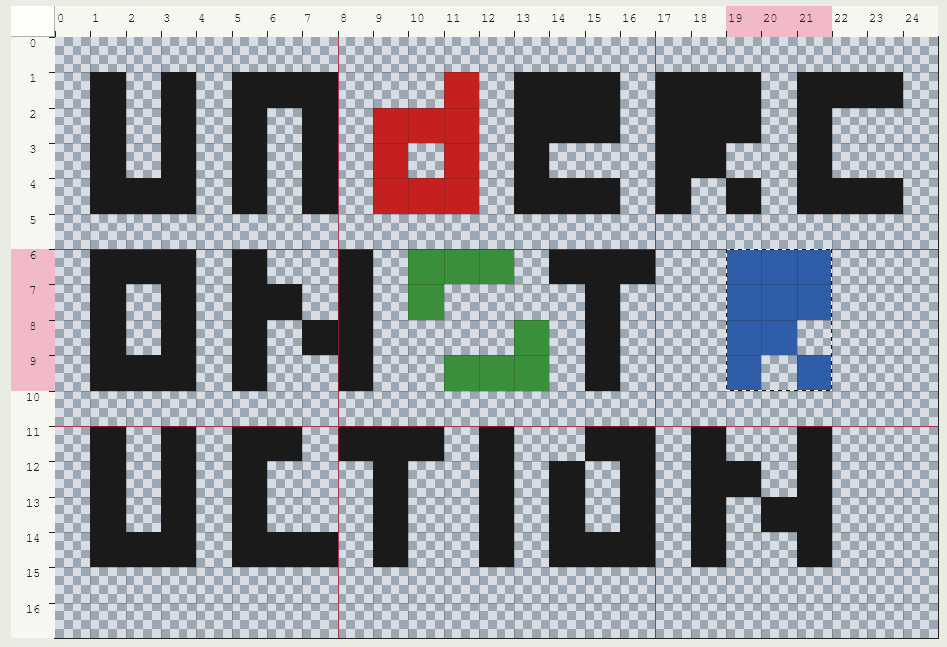
The workbench gradually acquired exact pixel-aligned zooms, a device-pixel-aware canvas, guides, rulers, selection, movement, clearing, cropping, file slots, a catalogue, PX9 import, PNG import and export, memory safeguards, and increasingly specific rules about what must happen when a checkerboard is visible below 32× zoom.
This sounds excessive until a single blurred grid line appears between two pixels. At that point, all previous restraint becomes morally indefensible.
The interface is built around one-screen use where possible. AREA holds the image and its tools. FILES handles the small local catalogue. IMPORT / EXPORT deals with the unavoidable moment when a tiny private format has to communicate with the outside world. The editor is not trying to become Photoshop. It has enough trouble becoming PIXXEL.
8 × 3, because coincidence needed a user interface
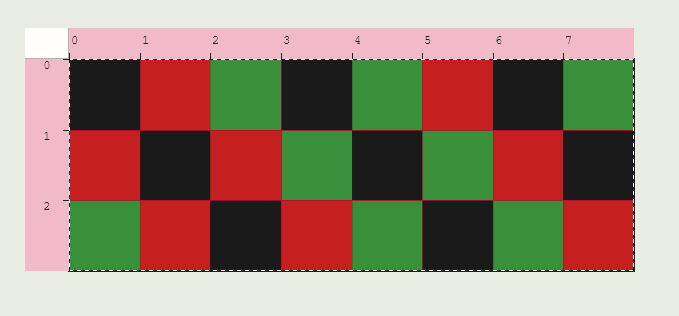
One of the early test images used an 8 × 3 grid: twenty-four cells in red, black, and green.
That arrangement became more than a test. CLINDUST has eight letters. 8 × 3 = 24. A day has twenty-four hours. 24 × 60 = 1440, which is also the width and height of the Daily Square images. None of this proves anything, but it is considerably more entertaining than naming breakpoints large, larger, and large-final.
nine colours and one very serious border
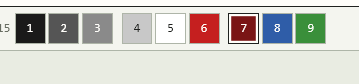
The palette is intentionally small. Each colour is an actual working value, not an invitation to spend the afternoon moving a hue slider by 0.7 degrees and then selecting the original value.
Selecting a colour sounds trivial. It becomes less trivial when the selection marker changes the apparent value of pale swatches, browser antialiasing invents a half-tone, or a border lands between device pixels. PIXXEL therefore treats palette geometry with the solemnity normally reserved for structural engineering.
a tool, not a manifesto
PIXXEL is still evolving. It already works as a practical editor for the images it was designed to handle, but the point is not to produce the world’s most comprehensive pixel-art application. The world has survived perfectly well without another one.
The point is to make a small, personal tool with a clear format, predictable behaviour, and an interface that belongs to the same visual system as clindu.st. It stores tiny pictures without ceremony, exports them when necessary, and remains opinionated enough to resist becoming a general-purpose application.
That is the experiment: not whether pixels can be edited, a mystery settled some decades ago, but whether a tool can stay deliberately small after its owner keeps having ideas.
Concept, product direction, testing, and prolonged pixel-level stubbornness — CLINDUST. Implementation partnership — Cody / Codex. Editorial development and highly necessary commentary — Charley / ChatGPT.